
How Smart Estates Achieve 98%+ Dues Collection by Linking Gate Access to Service Charges
Automating levy compliance at the estate gate eliminates manual debt collection, protects operational budgets, and recovers unpaid dues without guard friction.
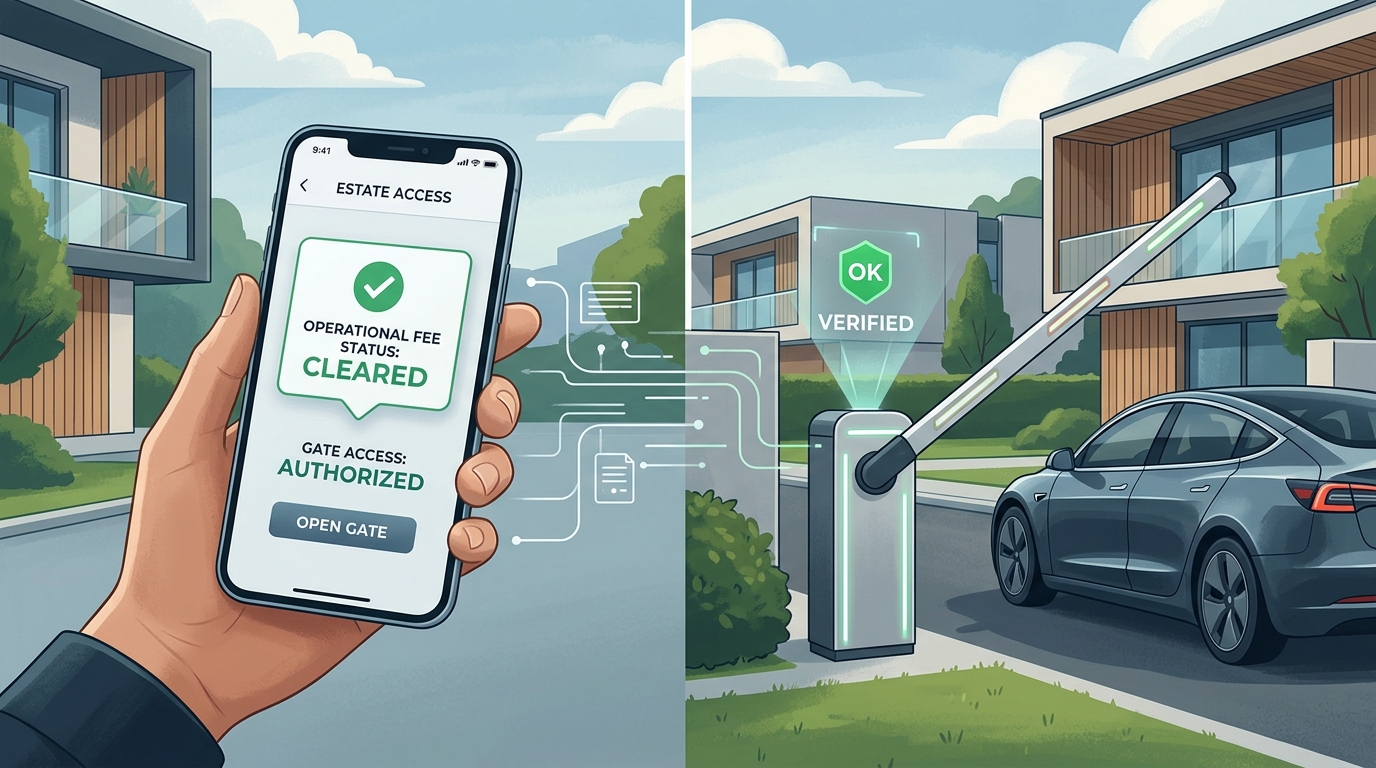
Residential estate associations and facility managers often struggle with uncollected service charges, delayed levies, and the unpleasant friction of chasing defaulting homeowners. Traditional recovery methods—such as manual phone calls, printed reminder letters, or awkward security guard confrontations—rarely work and drain managerial resources.
By integrating digital gate access control directly with estate accounting, progressive estates are solving the service charge deficit automatically.
The Cost of Uncollected Estate Dues
When service charge compliance drops below 85%, estate operations suffer quickly:
- Perimeter security staffing and guard salaries are delayed.
- Common-area lighting, generators, and water pumping maintenance get deferred.
- Paying residents grow frustrated by subsidizing non-paying neighbors.
- Debt collection efforts create administrative overhead and interpersonal conflict.
Chasing dues manually treats the symptom rather than addressing the structural workflow.
The Automated Gate Access & Levy Workflow
Clearaccess links resident account status directly to visitor pass generation and gate credentials.
flowchart TD
  accTitle: Resident dues and gate-access workflow
  accDescr: Clearaccess checks the resident’s service-charge status against gate rules. Current accounts keep visitor passes and hands-free ANPR access; overdue accounts receive a temporary guest-pass restriction and a payment prompt.
  account[Resident dues account] --> status[Service-charge status]
  status --> rules[Gate governance rules]
  rules --> current{Account current?}
  current -->|Yes| active[WhatsApp visitor passes and hands-free ANPR entry]
  current -->|No| overdue[Temporary guest-pass restriction and payment prompt]
1. Transparent Notice Windows
Estates set clear grace periods (e.g., 7 days past the monthly due date). Residents receive automated payment notifications with direct digital checkout links before any gate restrictions apply.
2. Automated Visitor Pass Restrictions
If an account remains default past the grace period, the system temporarily pauses visitor QR code creation from the resident app. Primary resident vehicle access remains operational, ensuring legal and reasonable access while removing guest convenience perks until dues are settled.
3. Instant Payment & Automatic Unlocking
The moment an overdue resident settles their service charge balance online via bank transfer or card payment, their visitor pass generation rights and full access privileges restore automatically within seconds.
Eliminating Gate Cash Handling
In addition to resident levy recovery, traditional gate operations often lose revenue through manual cash collection for visitor passes or overstay parking.
Clearaccess digitizes all gate financial transactions:
- 100% Cashless Gate: Guards handle zero physical currency, preventing leakage or discrepancies.
- Automated Overstay Fees: Commercial vehicles or long-stay visitors pay fees directly via mobile checkout links before gate exit arms release.
- Reconciled Manager Dashboards: Every payment maps directly to the estate's central treasury account with complete auditability.
Results: From 60% to 98%+ Recovery Rate
Estates implementing gate-integrated levy governance report dramatic operational turnarounds:
- Dues Recovery Rates: Increase from an average of ~65% to over 98% within the first 60 days.
- Zero Guard Friction: Guards no longer act as debt collectors; system rules handle enforcement neutrally and consistently.
- Predictable Budgets: Facility managers gain financial stability to upgrade estate security hardware, power backups, and common infrastructure.
By aligning gate access perks with community financial responsibility, smart estates protect their operational budgets while maintaining resident harmony.
Keep exploring.
Continue with field guides connected to this topic.
Multi-Gate Estate Operations: Managing Main Entrances, Service Gates, and Pedestrians in One Dashboard
How centralized multi-gate management unifies vehicle barriers, construction entrances, and pedestrian turnstiles into a single real-time dashboard.
Read the storyReplacing Falsified Paper Logs with Tamper-Proof Digital Gate Audits
Paper logbooks offer optical security without real protection. Discover how encrypted digital pass logs and overstay tracking eliminate perimeter vulnerabilities.
Read the storyEstate Rule Enforcement Without Gate Conflict
Dues, visitor fees, and access restrictions should be enforced through clear workflows instead of gate-side arguments.
Read the story